
The Bank Always Wins: 34 Years of Kenya's Interest Rate Data
A data analysis of commercial bank weighted average rates from 1991 to 2025 reveals one persistent truth: the gap between what banks charge borrowers and what they pay depositors has averaged 9.5 percentage points for three decades.
"For 34 years, across crises, policy reversals, and economic cycles, Kenyan banks have maintained a lending-deposit spread averaging 9.51 percentage points. The institution has always been the winner."
What 34 Years of Data Reveals About Kenya's Banking System
We analysed 413 months of commercial bank weighted average interest rate data from the Central Bank of Kenya — spanning July 1991 to November 2025. The dataset covers four rate series: Deposit, Savings, Lending, and Overdraft.
The headline finding is simple and uncomfortable: across four decades, political transitions, currency crises, a global financial shock, a pandemic, and multiple CBK rate cycles, Kenyan commercial banks have maintained an average lending-deposit spread of 9.51 percentage points.
The Peaks and the Troughs
The data contains four distinct rate regimes.
The post-liberalisation crisis (1991–1995) was the most volatile period on record. Lending hit its all-time peak of 32.28% in April 1994, driven by the collapse of financial sector discipline following rapid liberalisation. Deposit rates briefly touched 23.43% in November 1993 — the only time in this dataset that depositors came close to being compensated fairly for inflation risk. Overdraft rates reached 33.5% in December 1993, the series maximum.
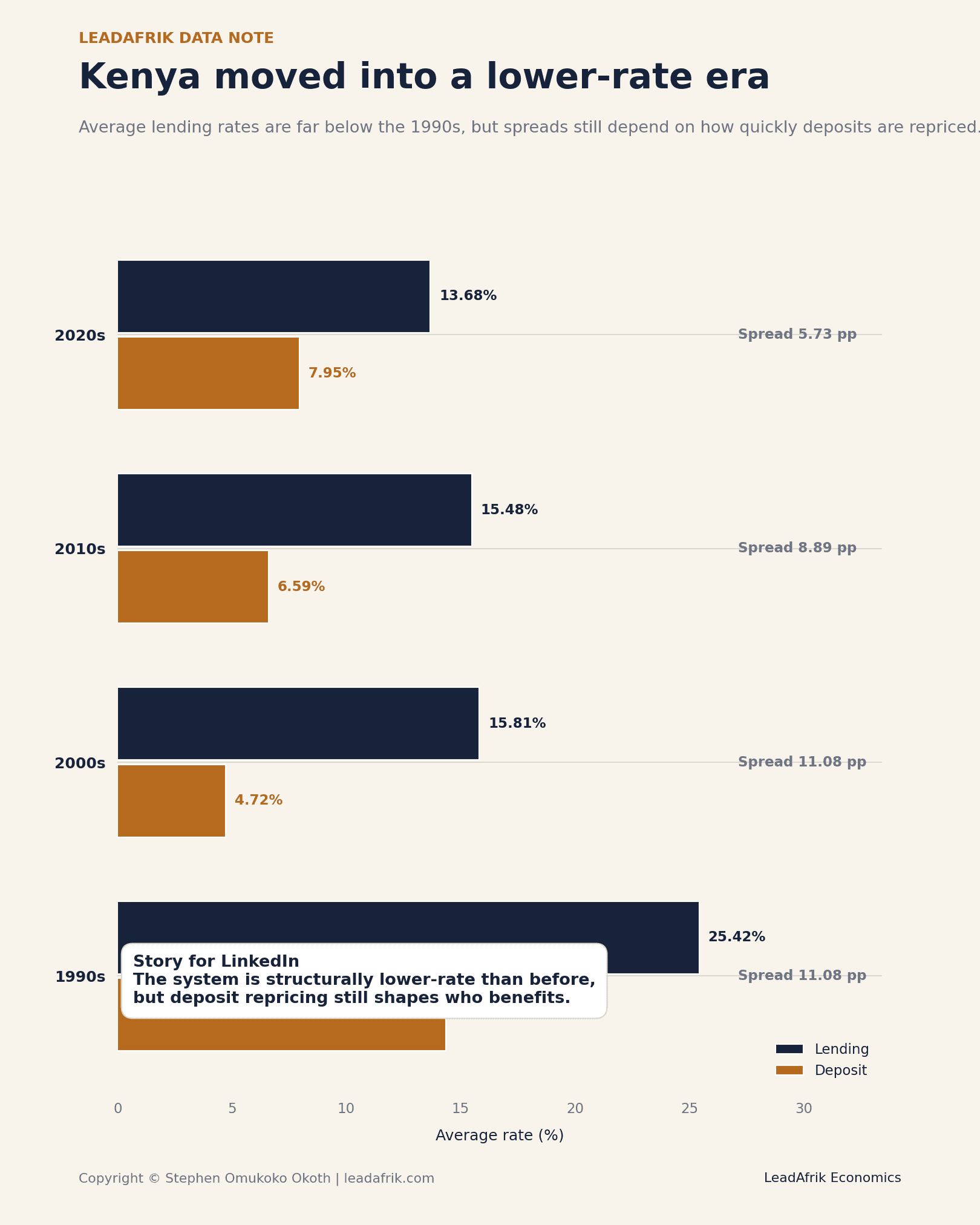
The long compression (2000–2010) saw lending rates normalise in the 15–18% band. But the adjustment was asymmetric. Deposit rates fell far faster than lending rates: the average deposit rate in the 2000s was just 4.72%, while lending averaged 15.81%. Savings rates collapsed to a low of 0.96% in February 2005 — essentially zero in real terms.
The era of anchored lending (2010–2019) produced the most stable rate environment. Lending averaged 15.48%, deposit rates recovered modestly to 6.59% on average. The interest rate capping law (2016–2019) briefly compressed spreads but was repealed after credit to the private sector contracted sharply.
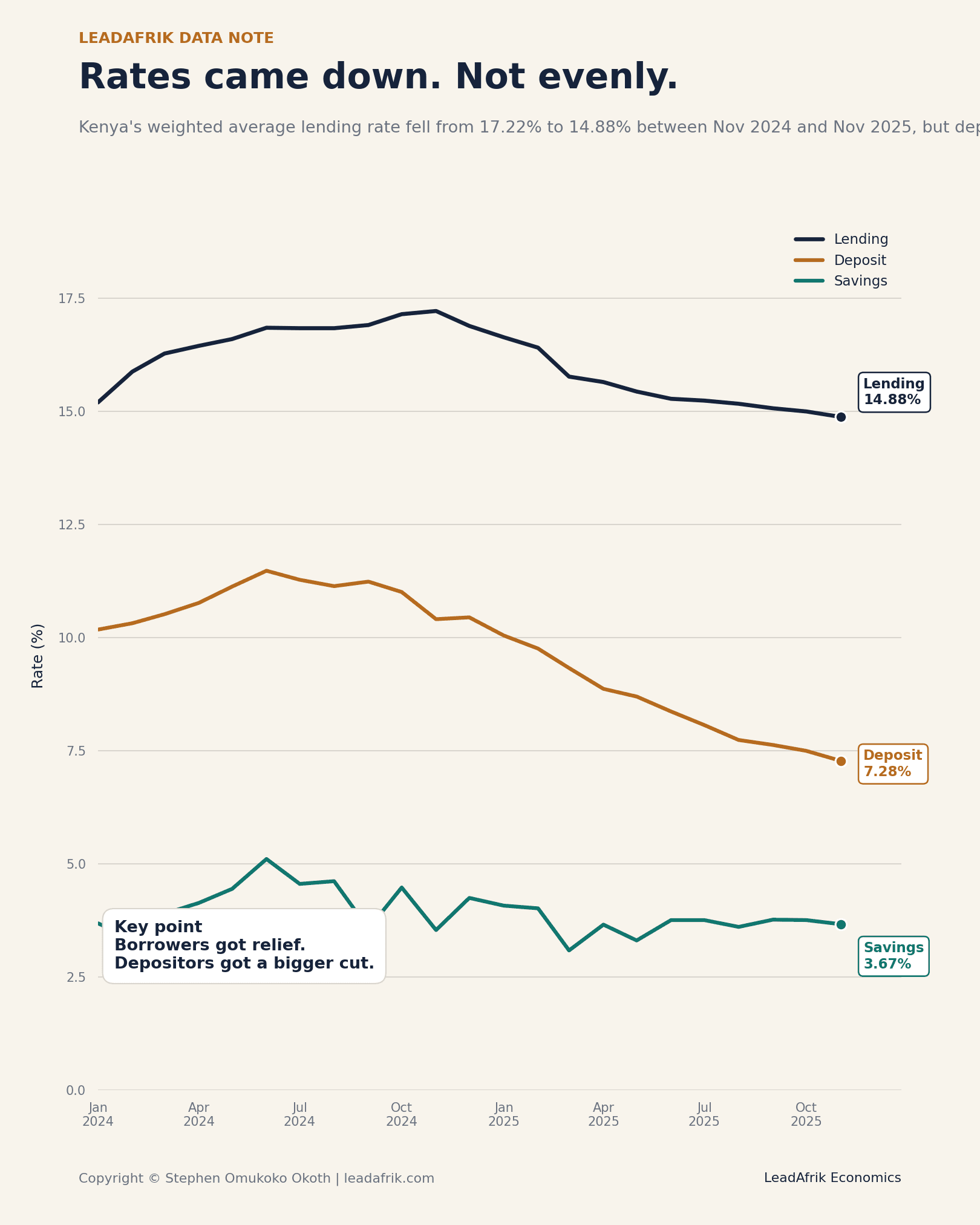
The 2020–2025 cycle is the most policy-visible period in the data. Lending hit its all-time low of 11.75% in September 2020 as the CBK cut rates aggressively during COVID-19. The subsequent tightening cycle pushed rates back up, before the current easing cycle drove lending from 16.64% in January 2025 down to 14.88% by November 2025.
The Spread: Where the Story Lives
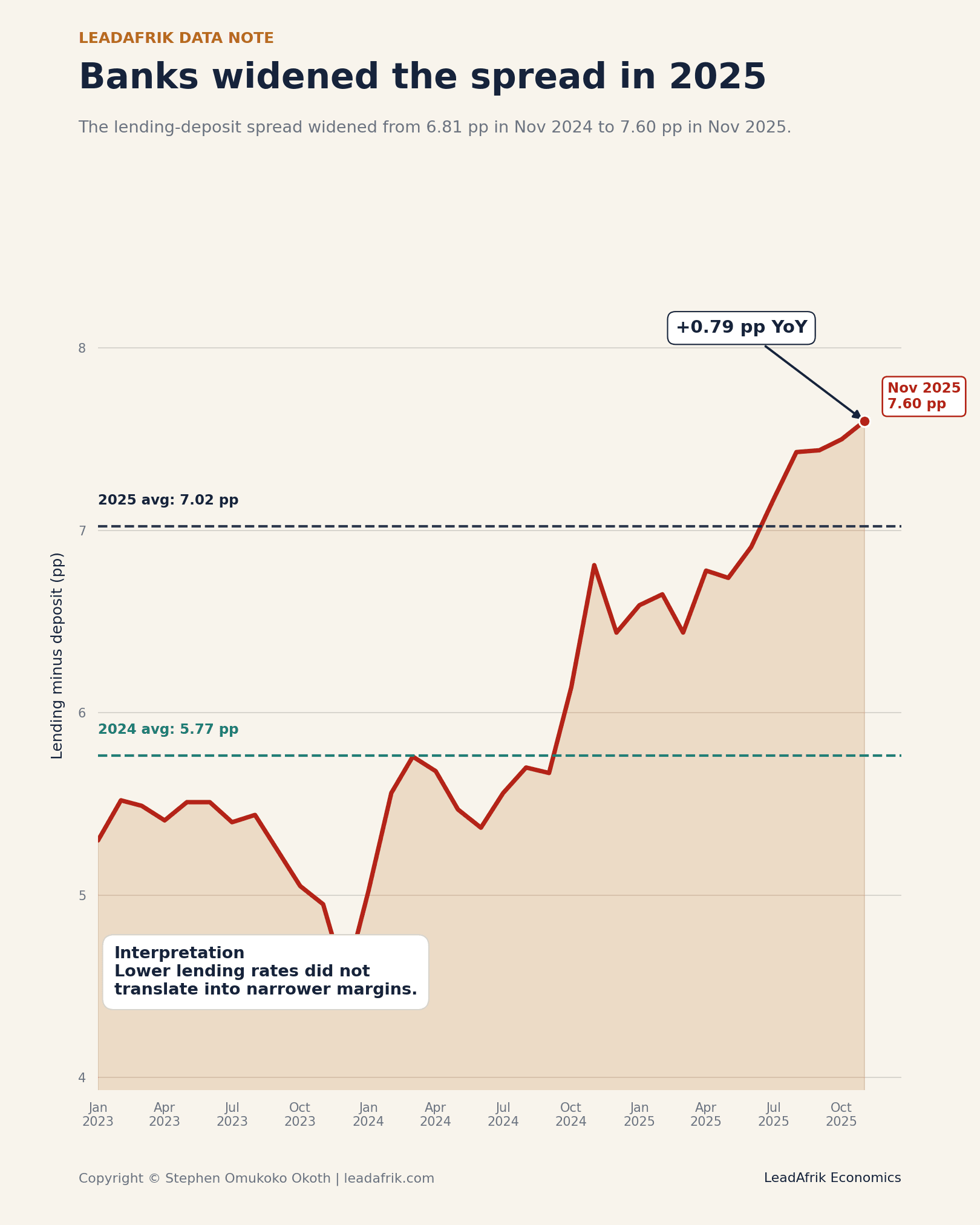
The lending-deposit spread is the most analytically revealing series. It measures how much of each lending rate banks retain versus pass to depositors.
| Metric | Value |
|---|---|
| Average spread (1991–2025) | 9.51 pp |
| Peak spread | 16.22 pp (December 1995) |
| Minimum spread | 2.83 pp |
| November 2025 spread | 7.60 pp |
The spread has narrowed in the current easing cycle, but depositors are still receiving 7.28% while borrowers pay 14.88% — a gap that has historically never closed below 2.83 percentage points.
The overdraft-lending spread tells a different story. On average it is nearly zero (-0.10 pp), meaning overdraft and lending rates have moved almost identically over this period.
What Correlations Tell Us
All four rate series are highly correlated — correlations between 0.82 and 0.97 — confirming that the CBK policy rate transmits across the full rate structure. However, the transmission is not symmetric: deposit rates respond faster to rate cuts than to rate hikes, a pattern visible in every easing cycle in the data.
The Seasonality Finding
Aggregating across all years by calendar month reveals a mild but consistent pattern: January and February tend to have marginally higher lending and deposit rates than mid-year months. This likely reflects year-end liquidity positioning and January fiscal pressures, though the effect is modest given the long data span.
The 2025 Picture
The current easing cycle is the sharpest since 2020. From January to November 2025:
- Lending fell from 16.64% to 14.88% (−1.76 pp)
- Deposit fell from 10.05% to 7.28% (−2.77 pp)
- Savings fell from 4.08% to 3.67% (−0.41 pp)
Deposit rates are falling faster than lending rates in this cycle. Savers are bearing more of the adjustment than borrowers are benefiting from it. This is the structural pattern that 34 years of data consistently confirms.
What This Means
Kenya's commercial banking sector has maintained pricing power across every macroeconomic regime in this dataset. Rate cuts reach borrowers incrementally. Rate hikes reach depositors slowly. And savings rates — the rates paid to the majority of Kenyan bank customers — have been below 5% for most of the last two decades.
The question this data raises is not whether monetary policy transmission works. The data shows it does. The question is: who does it work for?
Data source: Central Bank of Kenya — Commercial Banks Weighted Average Interest Rates, 1991–2025.
Analysis by LeadAfrik. © LeadAfrik / omukokookoth@gmail.com
Share