AGPO: five years of Kenya's 30% procurement programme, in the data
The Access to Government Procurement Opportunities programme reserves 30% of public procurement for youth, women, and PWDs. Five years of KNBS data (2018–2022) shows where it's working, where it stalled, and where it's quietly off-balance.
AGPO — Access to Government Procurement Opportunities — is a Kenyan programme and legal requirement that 30% of public procurement opportunities are reserved for women, youth, and people with disabilities. The programme was launched by former President Uhuru Kenyatta in October 2013, with the goal of facilitating the participation of women, youth, and people with disabilities in government procurement opportunities.
I looked at data on the programme between 2018 and 2022. Here are some findings.
The 2019 collapse
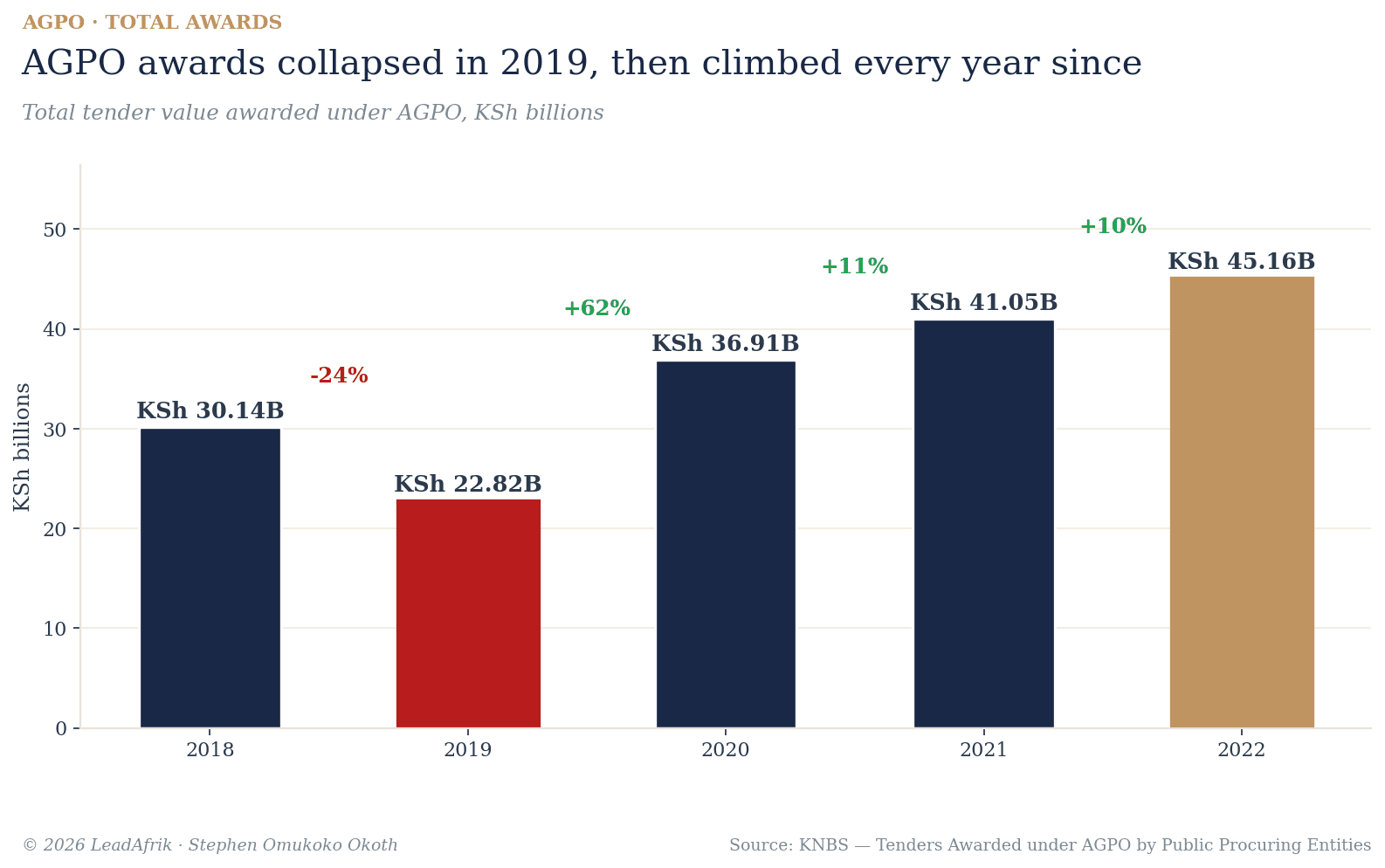
There was a significant collapse in the award value of tenders in 2019 — a fall of 24%. The award value fell from KSh 30.14B to KSh 22.82B in a single year.
That decline rebounded in 2020, rising by +62%. Then 2021: +11%. 2022: +10%. Pre-COVID drop, post-COVID recovery, and a decelerating climb afterwards. The data does not say what caused the 2019 cliff, but the dip is visible across both award value and tender count, and across all three categories.
The 30% floor isn’t split evenly
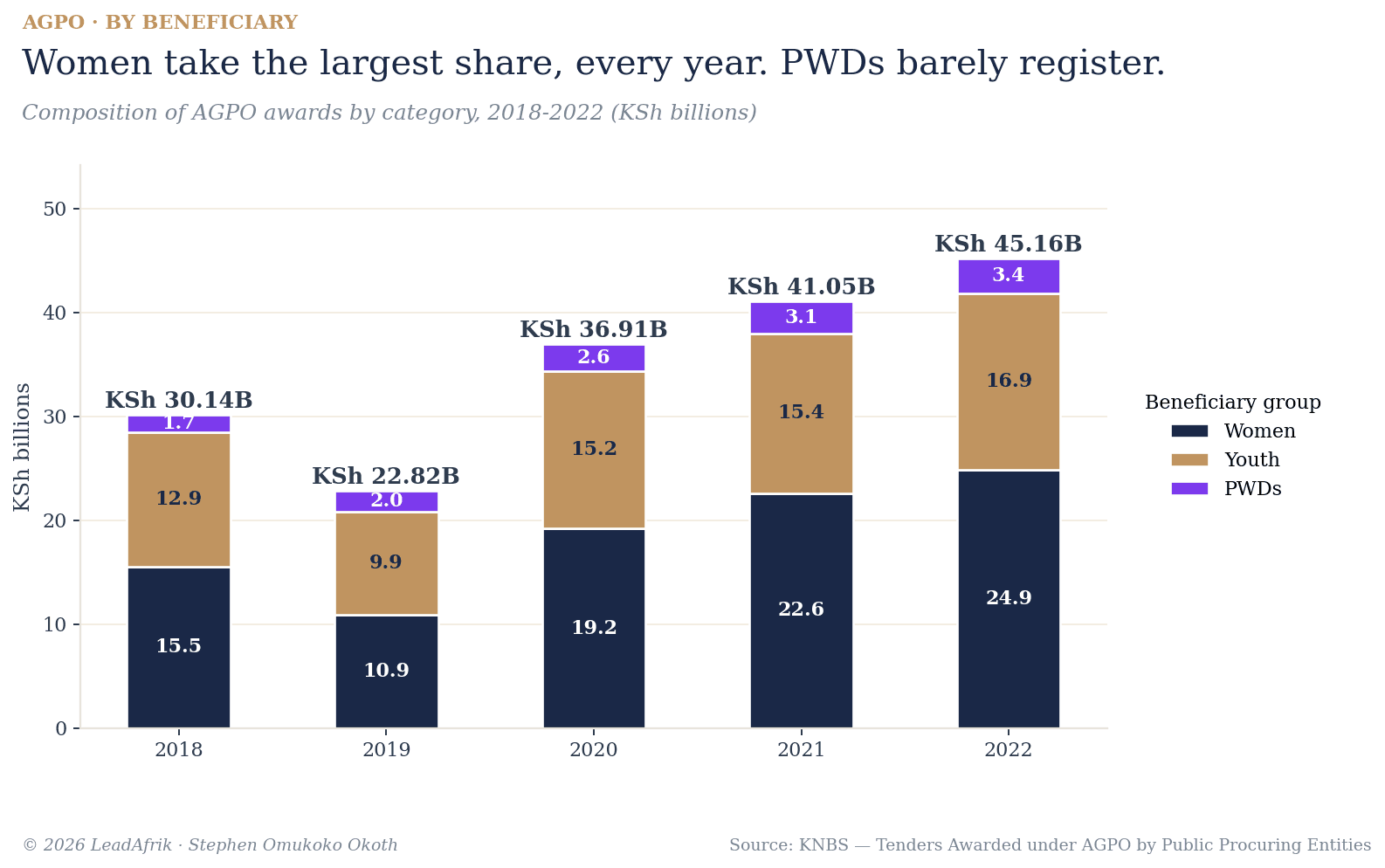
Women take 55% of awards while PWDs get 7.5%. Every year. The 30% floor is split very unevenly across the three groups it was designed to protect.
Women dominated every year of the dataset. Youth were a steady second. PWDs grew the fastest in percentage terms (+101% over five years) but added the smallest absolute amount — the legal architecture treats Y/W/PWDs as a single 30% bucket without disaggregated targets, and PWD-owned firms end up with what is left over.
Three entities run the entire programme
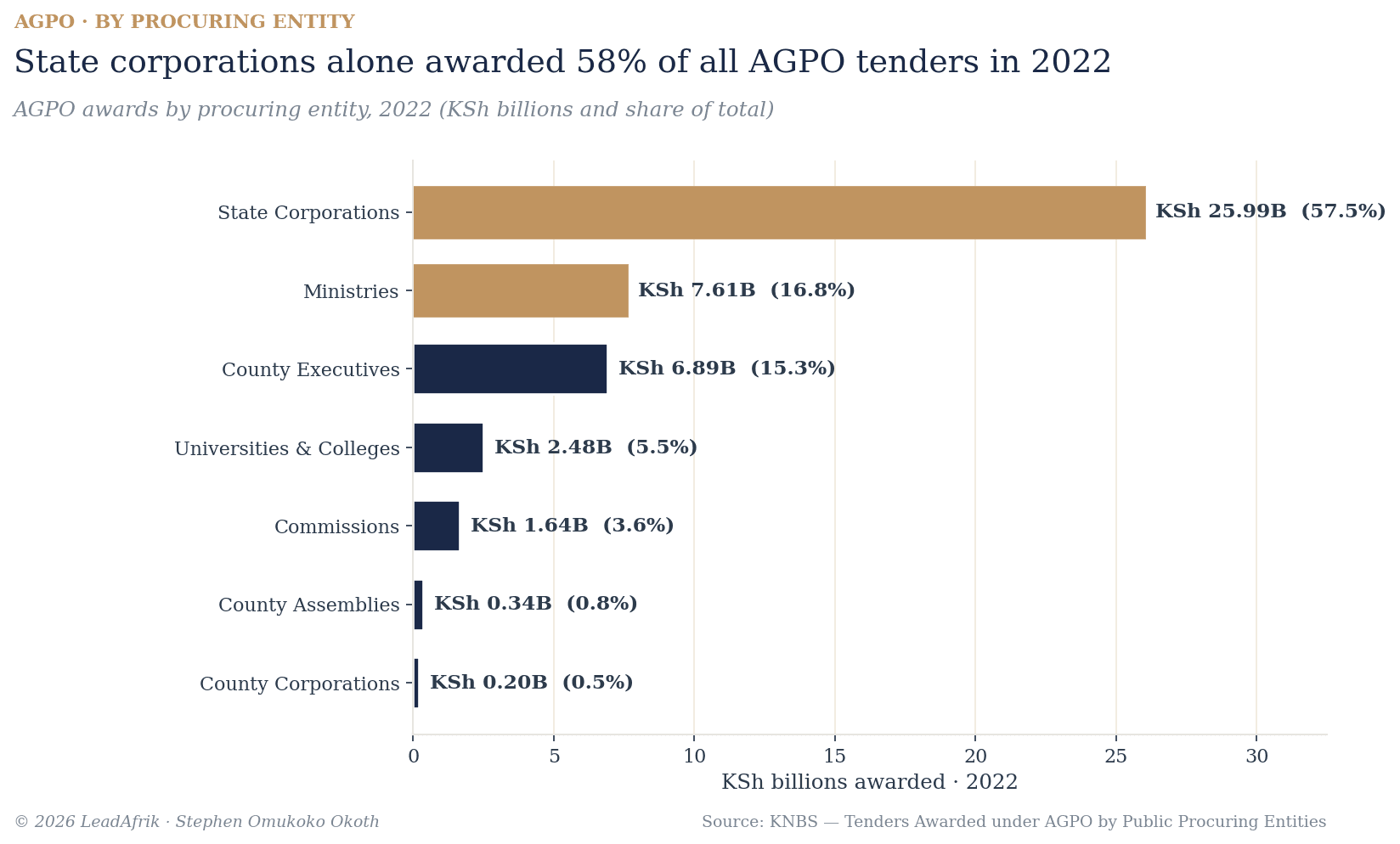
State corporations awarded 58% of all AGPO tenders in 2022. Add Ministries (17%) and County Executives (15%), and you’re at 90% of the programme. County assemblies and county corporations contribute under 1.5% combined.
The programme runs on parastatals, line ministries, and county governors — and almost nowhere else. County assemblies (the legislative arm) and county-owned corporations are functionally absent from the AGPO numbers.
Volume stalled, value didn’t
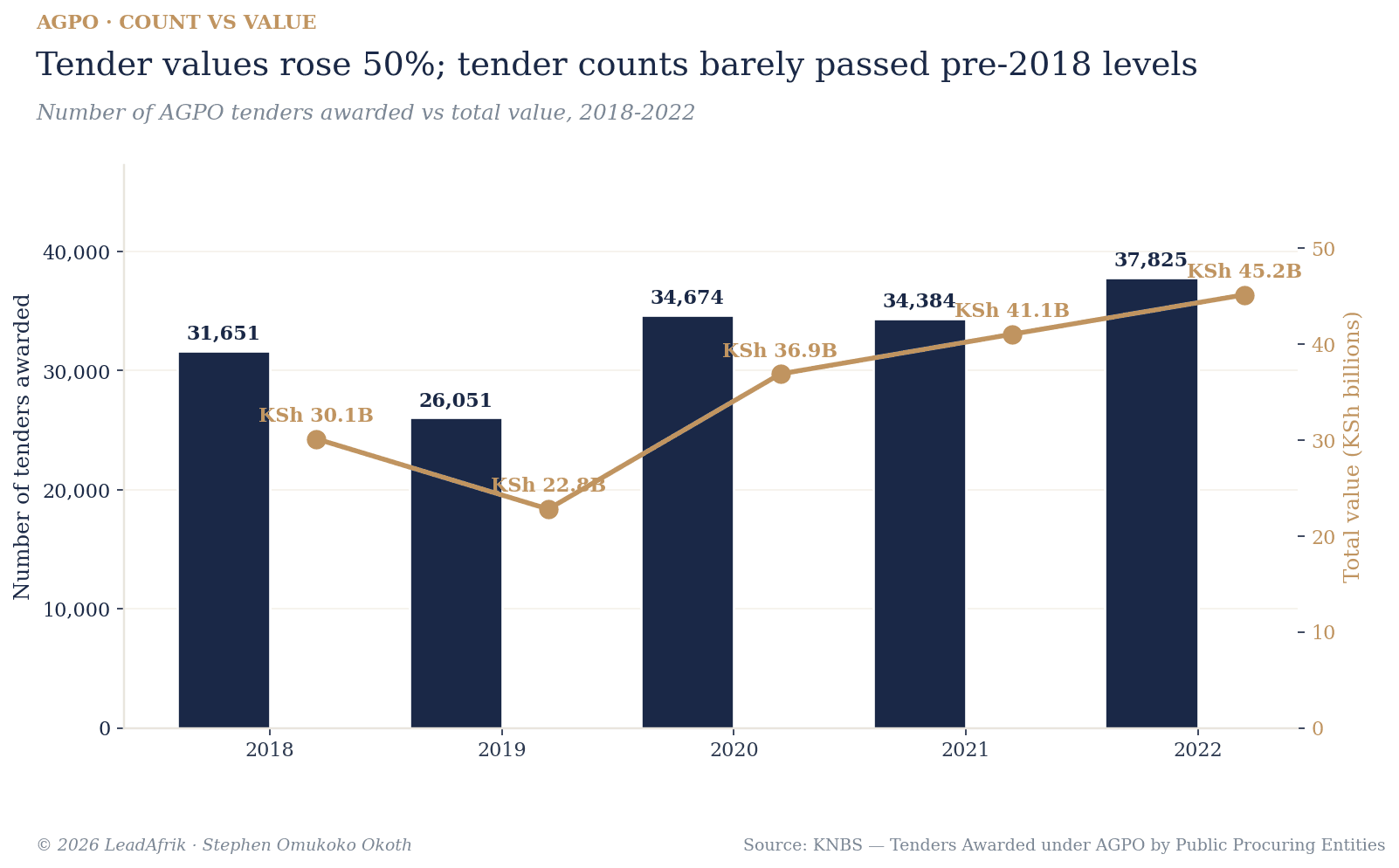
The volume slowed while the value didn’t. Tender count grew 19% over five years; tender value grew 50%. The programme is concentrating into bigger contracts going to a similar pool of firms.
Value grew about two-and-a-half times faster than count — meaning each year, the same broad set of AGPO-certified firms is winning bigger tickets. That’s a professionalisation story for the firms that already qualify, but it raises a real question about whether the programme is widening access — or just enriching the established AGPO contractor pool.
Women win more tenders, but they’re smaller
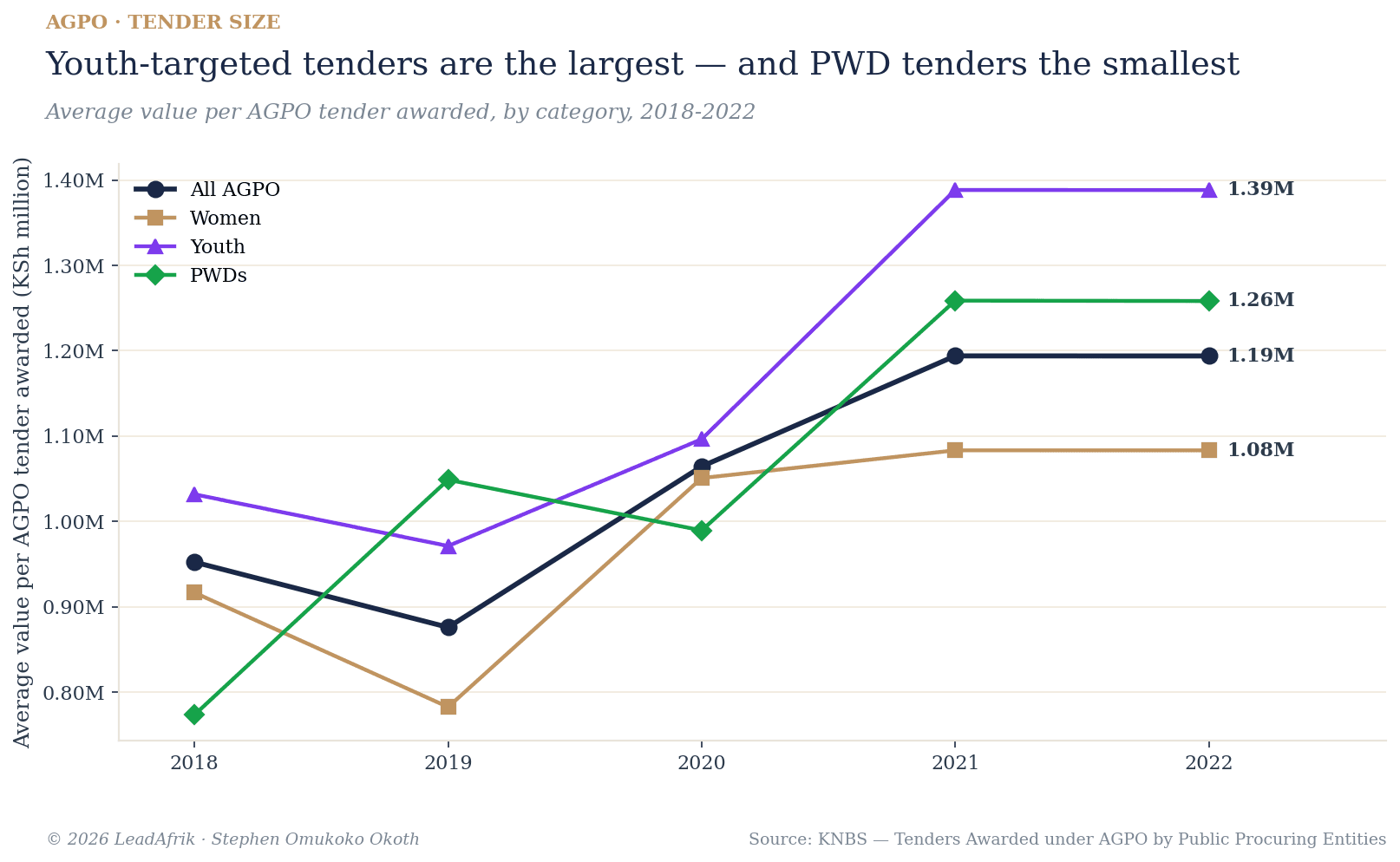
Women dominate by count but win the smallest tenders on average (KSh 1.08M vs Youth’s KSh 1.39M). The programme appears to be moving women into volume-heavy, lower-ticket categories and youth-owned firms into higher-value work. That’s a composition question worth asking.
In 2022 women won 22,965 tenders to youth’s 12,184 — almost twice as many — but the average youth tender was 29% larger. PWD tenders fell between the two at KSh 1.26M. The headline numbers of who is winning AGPO awards tell only part of the story; the composition of work each group is being directed toward is a separate, equally important variable.
What this leaves us with
Twelve years after launch, AGPO has grown into a multi-billion-shilling programme. It is also structurally uneven across its three protected groups, structurally concentrated in three types of procuring entity, and increasingly concentrated into larger contracts going to the same pool of firms. None of that disqualifies the programme. All of it tells you where the design needs work.
For this and more, browse leadafrik.com.
Share
If this is useful, send it to someone who'll benefit.